In anticipation of Waanyi, Teppathiggi and Tjungundji multi-media artist, Jack Wilkie-Jans’ exhibition—his second solo for NorthSite Contemporary Arts—our Artistic Director, Dr. Russell Milledge, shares a Q&A with Jack.
Can you please explain the story behind your intriguing title, A Cruel Tutelage?
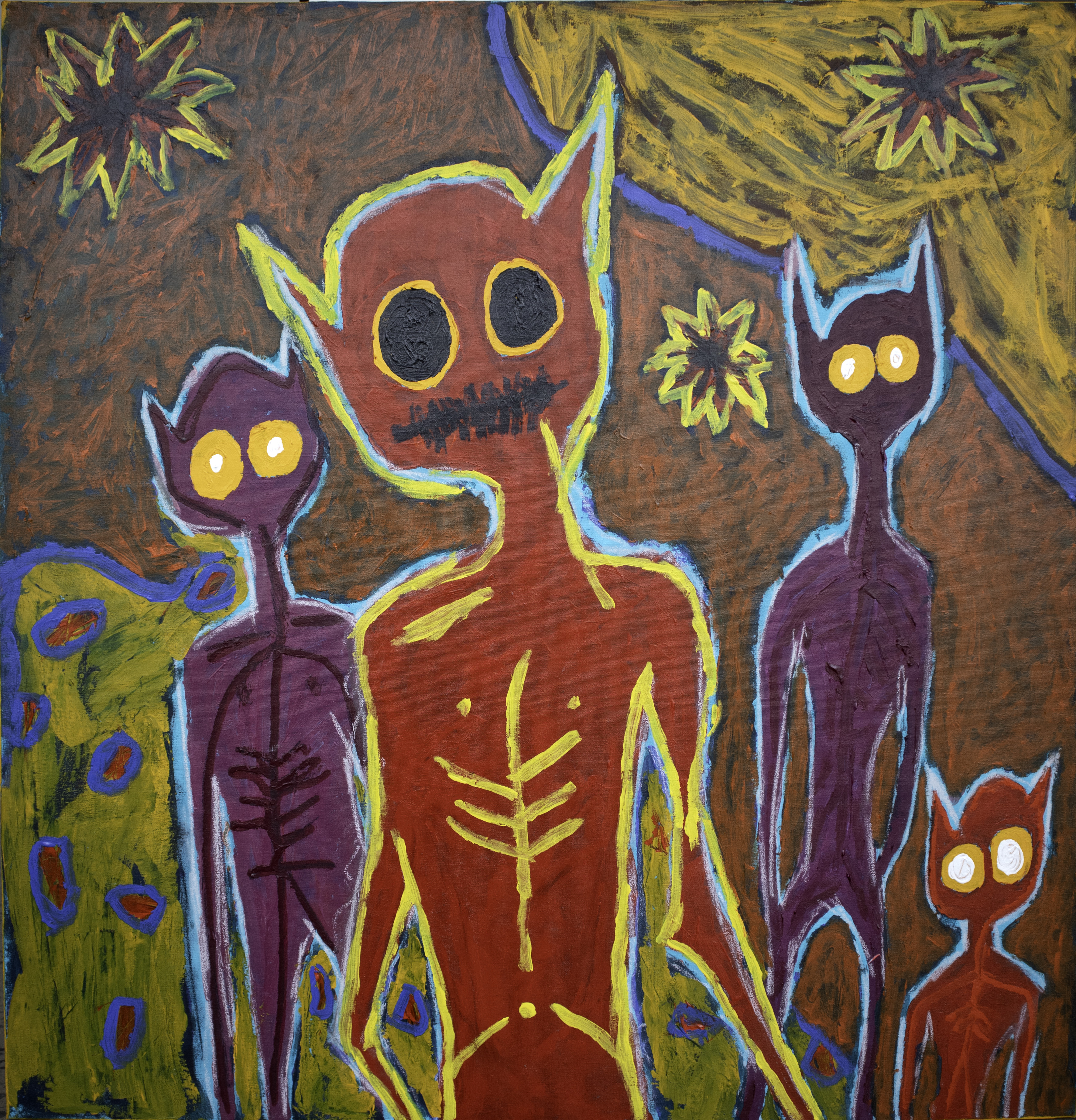
Here I’ve actually borrowed words from an early artwork I created for Umi Arts, under their then-curator, Teho Ropeyarn, in 2013. However, this work was re-named to Knowledgeable Savages before I exhibited it—it was a painting. I wanted the piece to represent the ‘trial and error’ origins of Indigenous peoples’ sustained and ancient traditional and survival practices. I, titularly, played on the colonialist and demeaning concept of a Noble Savage. Of course, the point I was making was to the contrary, rather exalting us as Enlightened First Peoples who have learned how to navigate the courses of nature with wisdom and power.
However, I couldn’t let go of the original title ‘A Cruel Tutelage’ because it held such a pronounced resonance to me… In spite of having had a joyous and safe childhood, and having a fulfilled adulthood, I’ve always felt that having a cruel tutelage is or will be my fate [one way or another]. As such, I knew it would have meaning one day, but also that I couldn’t carry this ‘jinx’ and paranoia with me any further and that it was time to shake it off through the mode (art) by which it first struck me. I’ve since made a lot of art and worked through a lot up to this point. I’ve lost so, so many loved ones. In fact, this will be my last show for the foreseeable future.
I also changed the title because it simply wasn’t apt to the concept of that original piece, which was to be about: Innate intrinsic qualities in how we First Nations peoples relate and bear ourselves through and over and on Country—we learn, we adapt. In fact, the artwork wasn’t even initially intended to look the way it does… But, I’ll get to my lack of painter’s skills below. As such, the words A. Cruel. Tutelage. all together spent over a decade with me. Until now. And, politically and societally speaking, we’re not out of the woods yet.
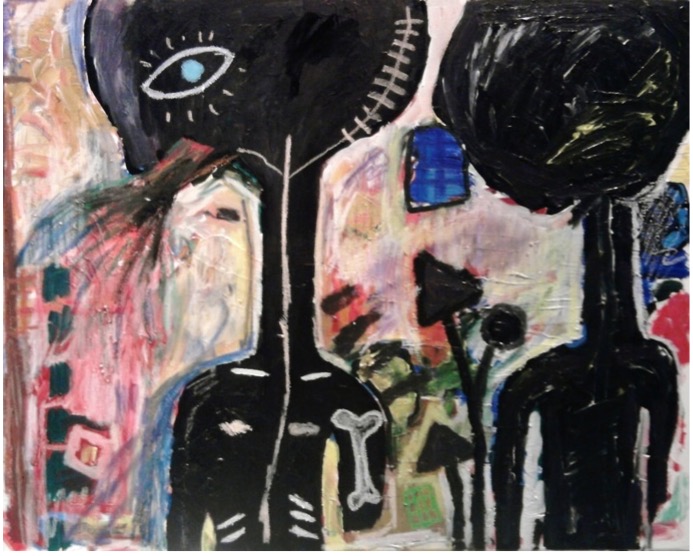
Knowledgeable Savages, 2013, Acrylic on Canvas, 60cm x 75cm x 2cm, Jack Wilkie-Jans.
How does the exhibition title ask audiences to relate to the show and to the individual pieces therein?
Today, the ‘A Cruel Tutelage’ emphasis can be recognised across every facet of our First Nations Peoples’ survival and all of our trials and tribulations over the past 250 (odd) years. (There are other works which speak to the COVID-19 times of dissonance and disassociation). Though, there’s so much more to our psyches than what colonialism contributes. We’ve had cruel tutelages, yes, but also an overwhelming tutelage of love and of belonging, and of craft (physical and metaphysical) and story. As such, it’s my hope that the visuals and soundscapes within this exhibition, and its title—which are somewhat of the spooky—are embraced by audiences as a spiritualistic challenge to the fears we all carry and move to leave behind; whilst also recognising the peace, love and beauty, and safety, First Nations peoples are reclaiming under our Sovereignty Re-Realised.
We all wish to see more clearly in the dark.
In depicting this now-equilibrium of my spiritual state and of my art, the ‘spooky’ artworks, along with the title, are all chosen for this exhibition as a utilisation of strong language (e.g. ‘cruel’) and aesthetic (e.g. the near or non-human and supernatural). Cruelty is regurgitated in theme and reabsorbed as artworks to recognise and name that which dogs [us]. After all, naming a fear, an evil presence, is first crucial to knowing it and then diminishing it. This act is a supreme and righteous accusation of moral and spiritual transgressions.
Can you walk us through your intention of creating what appear to be personas and masks in your digital media works? For example, do the portraits link together as aspects or faces of a single complex character?
Perhaps there is a ‘face’ which all the works share, while perhaps alternate personas may also seem to show through. But, in all honesty, these pieces are created as discretely as each heartbeat pulsates. This body of work isn’t reflective of any ambitious character-building such as all that alter-ego thing. I’m no David Bowie. In saying this, the works (created over the last five years) are adjoined and vital, but are indeed separate all the same. Each have unique purpose for the time they were created at—I just don’t pay too much attention as to what that purpose is… Hence these works showing now makes more sense to me in retrospect.
Let me disavow audiences: These images are not ‘me’. I myself am perfectly fine and Singular. I just couldn’t afford actors, camera assistants, costuming and make-up. If I take on characters, they’re merely glimpses of shadows (archetypes of the shadowy mind and troubled heart).
Besides, it’s YOU whom you should look to find in these works, not me.
Are there any specific identity themes or universal messages that you aim to convey through your work?
Oh yes. Several, in fact.
How do you choose the mediums and techniques that you use in your artwork, and do you have any favourites?
As I mentioned earlier, I’m not a master painter. Nor am I a prodigious or even trained musician or sound mixer/producer. Nor am I a trained video artist or photographer. Nor am I an artist who yearns and burns to create; I can live without making art. But, when I do move to make, I don’t like to be limited as much as I feel I actually am. As such, my formula is very simple: If I can’t paint it, I record it; if I can’t write it, I paint it; and if I can’t say it, I ‘sound’ it. As such, I play across painting, photography and moving image works, as well as ambient sound and poetry, out of sheer production-value necessity. However, I’ll rarely (if ever) attempt to [say] the exact same thing across multiple mediums. Meaning, what I chose to include in this exhibition are of themes I’m scarce to put to pen or speech in other forums.
As for a having a favourite mode, I’d say I’m more a painter, or, at least I’m a better painter. Though, my favourite media to use is digital and enhanced photography—no prosthetics needed and you can become anything.
Can you share any challenges or breakthroughs you’ve experienced while working on your art, and how they have influenced your growth as an artist?
I figure that many artists at my fifteen-year career stage would remark how their ‘canvasses’ are many and their horizons have continuously broadened as their practice develops and strengthens. I’d hope so anyhow. For me, I’ve simply learned what I don’t want to learn to do and what I don’t want to address through art. Restraint—I’ve learned restraint. Not just in messaging and action, but also in terms of my visuals. In terms of filmmaking, I’ve heard what I’m sure every artist has heard (and disregarded): Sometimes less is more. You won’t see this across my painting—I love more is more in painting (at least for the most part. Though, I can pull things back when I wish to). But, in my later moving image works, you’ll notice I strip back all things aesthetic, action wise, and let the sound and spoken work pull the rest together. David Bowie taught me this, too. In all his presumed and obvious excess, his schtick was pretty straight-forward, at its core. Overall, I’ve been very pleased with this approach to my own moving image art.
As for me as an artist and person, what creating these works and thinking on these works as it came to selecting works for this show, I’ve learned to be less prescribed and articulate (in what has been an overly articulated professional life until now, as a writer and Aboriginal Affairs commentator). It’s important for me that A Cruel Tutelage speaks for itself where it can, and that audiences may even share their own take. I present art as both an expression and also as a learning opportunity in hearing what themes and take-aways audiences themselves apply.